

When temperatures in England hit 40°C for the first time in 2022, the heatwave led to over 2,000 deaths. In 2023, Storm Babet devastated parts of Scotland. Tenbury Wells has been described as the UK’s first ‘uninsurable town’ due to the impact of flooding. Earlier this year a council in South Wales took the decision to purchase and demolish homes on Clydach Terrace because of the risks of climate impacts. These are not isolated incidents; they show the increasing human cost of climate change in communities across the UK.
Our leaders are aware of the crisis. In her October 2025 letter to Minister Emma Hardy, Baroness Brown, Chair of the UK’s CCC Adaptation Committee, advised that the country needs to better prepare for extreme weather caused by increasing climate change. The data referenced predicts an additional 15–25 cm of sea level rise by 2050 for UK coastal cities, increased instances of heatwaves, drought and severe storms, and a wildfire season that extends into autumn.
Whilst climate change is impacting all parts of the country, the devastation is felt most acutely by those least able to adapt. Research shows this includes low-income households, Disabled people, and black and racially minoritised people. They are often the people more likely to be exposed to high heat in poorly insulated homes, to live in flood-prone areas, to breathe in the most polluted air and to suffer with the rising costs of energy and food – including the added stress that comes with it.
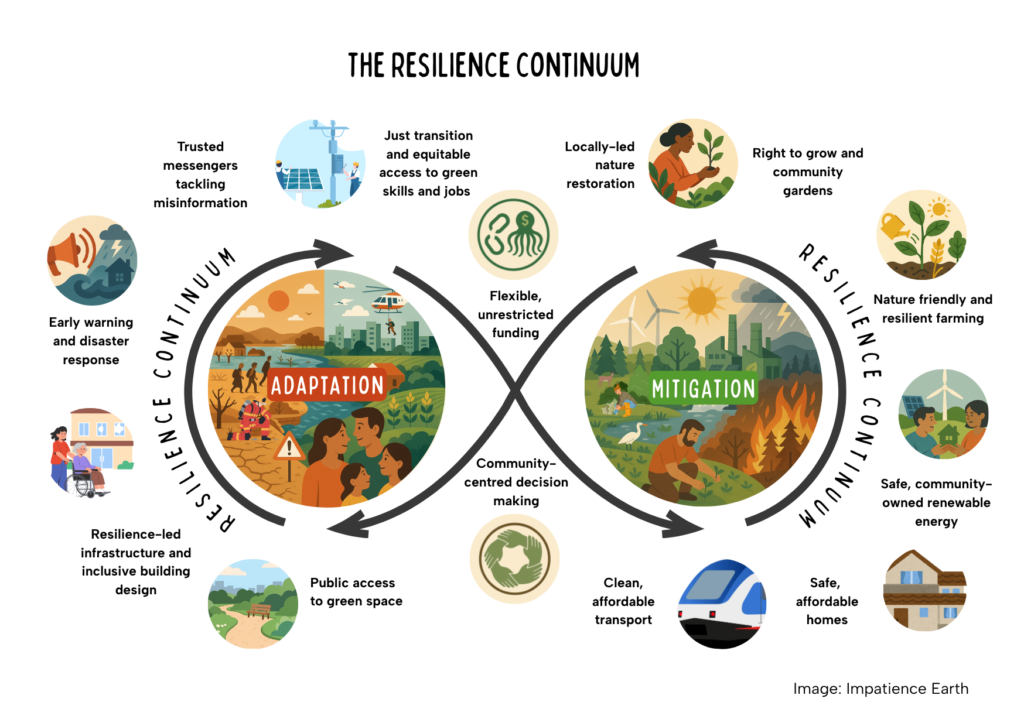
Yet we also know that there are countless people doing vital resilience-building work, in communities across the UK and often on a shoe-string budget. These are the community leaders who have the deepest understanding of local issues as well as the trust required to drive change forward in the long-term. In a term coined by Dr Shenaaz Moosa, resilience is a continuum that involves the spectrum of work that communities and leaders across the world are doing on a daily basis – not a one-off activity – and helps us move beyond the mitigation-adaptation binary. This is something we have communicated with Impatience Earth‘s Resilience Continuum (image below) to help our clients visualise how funding solutions across a continuum can have exponential impact, with empowered communities at the heart of it. When communities are have the resources to design their own solutions, this ensures that interventions are locally-led, contextually relevant and sustainable. Take, for example, the West End Women and Girls Centre in Elswick, Newcastle. This is the first charity to lease a farm from the National Trust and it is local women and girls who run the 10-acre smallholding in rural Northumberland. Over 4,000 women and girls have visited from the city, to learn new skills and meet new people. The charity increases their resilience in our era of climate change, polarisation and the rising cost of living.
A crucial insight from this work is how pushing for greater equity in our response to climate change can increase resilience for all. Over the last year, we’ve spoken to a number of philanthropic funders who are concerned about the UK’s rising inequity, grappling with the complexity of the issue and looking for solutions. In response, Impatience Earth released two reports, the first highlighted how women and marginalised groups in the UK are disproportionately impacted by climate change, and the second focused on the additional burden for Disabled people, neurodivergent people, and people with mental health conditions.
Our research found stark inequalities in the UK:
- Women spend twice as much time doing unpaid domestic and care work, which makes it harder to evacuate or recover during climate-related emergencies
- During floods and storms, social isolation risk increases – especially for Disabled people and neurodivergent people, yet their voices are often missing in climate policy decision making
- Air pollution has been linked to anxiety, depression, schizophrenia and post-partum depression, with women and racialised communities disproportionately impacted
- People with mental health conditions are three times more likely to die from heat related causes, and research shows that LGBTQIA+ people live with a higher baseline mental health burden, making climate shocks and eco-anxiety potentially more damaging
These reports highlight the issues, as well as the abundance of solutions. Some readers might be surprised to know that there are many organisations already working at the intersection of disability rights, gender and racial equity, socio-economic justice and climate resilience in the UK. They include: Women’s Environment Network, Friends of the Earth, Disability Rights UK, Community-Led Action and Savings Support, Climate Cymru, East Marsh United, AWETHU, Threads in the Ground and the Wildlife Trusts.
Through our work supporting philanthropic funders to accelerate their climate impact we’ve met people with lived experience of the issues, activists and NGOs of all stripes. The common thread is a shared belief in the power of people to solve our most complex challenges, and the desire to keep working to build a better future for us all, including the generation that has not yet been born.
We also know that building a better future depends on change at the systemic level. Impatience Earth recently brought together practitioners, funders, and advocates to ask what it would take to build a genuine ecosystem for gender-just climate work in the UK. Their answers included:
- A call for people in positions of power to actively make space for marginalised voices
- Meet people’s basic needs as part of climate policy, including affordable housing, energy, food, transport and childcare
- Acknowledge that violence against women is both a cause and a consequence of the climate crisis
- Fund physical spaces for women, girls and marginalised genders to meet and work in-person
- Protect free access to green spaces, and spaces to grow food locally
Against a backdrop of increasing climate impacts, polarisation and the rising cost of living, it’s vital that UK funders seize the window of opportunity to sustain and strengthen resilience building work at the community level. Our message to funders is: now is not the time to pause or slow down. This is the time to recognise the threat of climate change, ramp up your funding and double down on equity. Organisations like Impatience Earth, the Environmental Funders Network and Philea can help you to accelerate your impact and connect with others on the same journey. We know the climate crisis is accelerating inequity, will this be the year that your organisation steps up in response?
Sarah Farrell is a Director at Impatience Earth, a climate philanthropy consultancy that advises foundations, corporates and high net worth individuals to take bolder funding decisions to address the climate emergency. To learn more about working with Impatience Earth, contact sarah@impatience.earth
Climate Solutions Magazine: April 2026
We encourage you to read this edition of the F20 Climate Solutions Magazine in full. We invite you to take some time to read these thought-provoking articles, which focus on the leaps and bounds that can be made in climate work through networked learning and local, community-led action.
Expand the preview below and immerse yourself in these thought-provoking articles.